
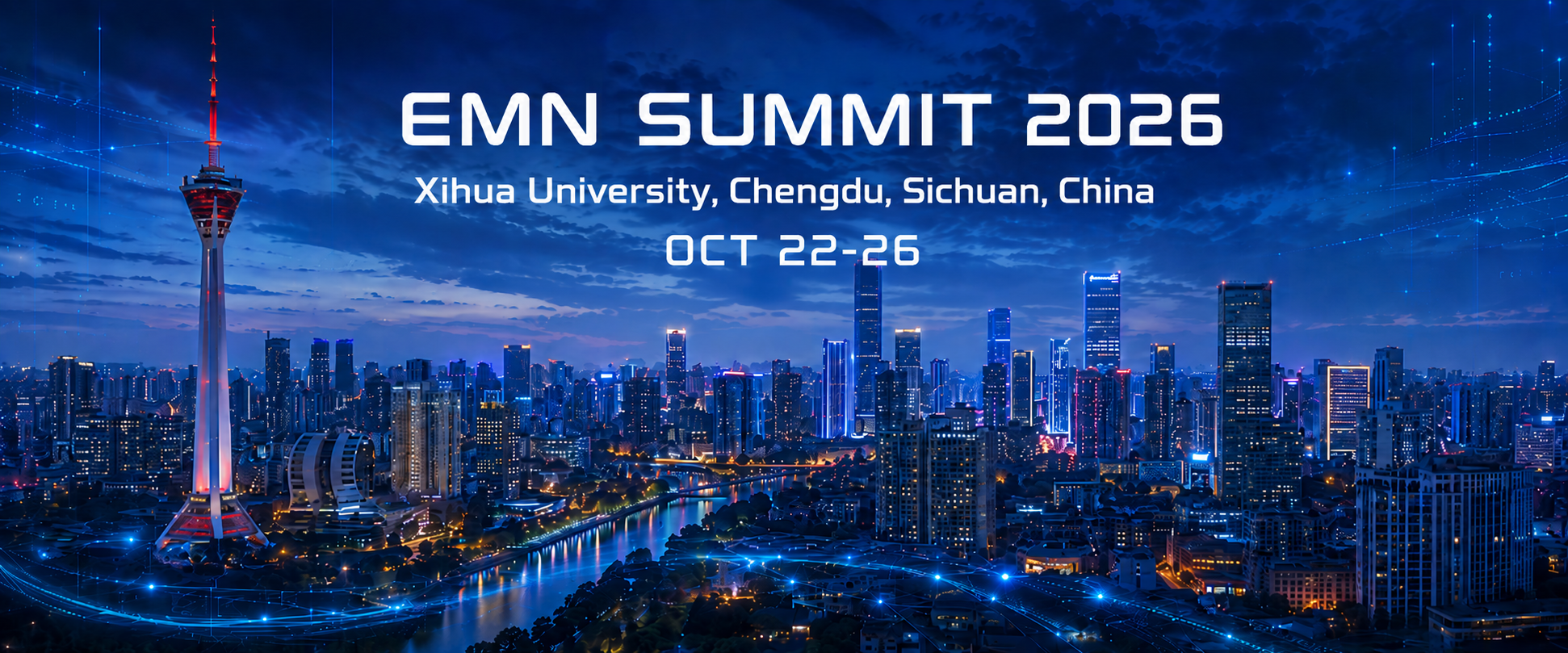
Introduction to EMN Summit 2026

The Energy, Materials and Nanotechnology (EMN) Conference series began in 2008 as a focused academic workshop and has since developed into an international platform for scientific exchange in energy, materials, nanotechnology, and related interdisciplinary fields.

Over the years, EMN meetings have brought together researchers, engineers, industry professionals, and young scholars from different countries and regions, supporting academic dialogue and collaboration across universities, research institutions, and technology sectors.

EMN Summit 2026 will continue this international tradition while further strengthening academic exchange between Chinese and international scientific communities, with a focus on frontier research, emerging technologies, and interdisciplinary collaboration.

DATE
October 22–26, 2026
VENUE
Xihua University
Chengdu, Sichuan, China

Conference Program

22–26 October 2026 | Xihua University, Chengdu

Friday, 23 October 2026

Venue: Room 101, Office Building, Xihua University, Chengdu, China
Quantum Science, Nanophotonics and Electromagnetic MetamaterialsSession Chair: Arup Neogi
09:00-09:25
Opening Ceremony
09:25-09:45
A01Hybrid boson sampling-neural network architecture for enhanced classification
Abolfazl Bayat
University of Electronic Science and Technology of China, China
09:45-10:05
A02Achievability of Heisenberg Limit via Quantum Zeno Dynamics and Dynamical Decoupling
Tan Kok Chuan Bobby
University of Electronic Science and Technology of China, China
10:05-10:20
A05Optical detection of magnetic order in 2D magnetic materials
Mateusz Goryca
University of Warsaw, Poland
10:20-10:35
Coffee Break
10:35-10:55
A03Ultrafast Chiral Phonon Oscillations in Nano Colloids
Arup Neogi
University of Electronic Science and Technology of China, China
10:55-11:10
A12Nanomagnetic Interface Design for Low-frequency Electromagnetic Wave Absorption
Mingyue Yuan
Xihua University, China
11:10-11:25
A11Development of Additive Manufactured Invar Alloy and Its Metastructure through High-Throughput Intelligent R&D Platform
Ke Huang
Xihua University, China
11:25-11:40
A06Engineering I-III-VI Colloidal Quantum Dots for Bright, Narrow-Band Emission toward Next-Generation Displays
Ali Imran Channa
Southern University of Science and Technology (SUSTech), China
11:40-11:55
A07Colloidal quantum dots for display
Lei Jin
Southern University of Science and Technology (SUSTech), China
11:55-14:00
Lunch Break
14:00-17:00
Academic Exchange / Laboratory Visits

Program subject to updates. Times are local (China Standard Time, UTC+8).

EMN SUMMIT 2026

Confirmed Participants

Researchers and scholars joining EMN Summit 2026 from institutions around the world.

Naeem Akhtar

Associate Professor

Bahauddin Zakariya University

Pakistan

Ramon Alvarez-Puebla

Professor

Universitat Rovira i Virgili

Spain

Dinsefa Mensur Andoshe

Associate Professor

Adama Science and Technology University

Ethiopia

Abolfazl Bayat

Professor

University of Electronic Science and Technology of China

China

Ali Imran Channa

Southern University of Science and Technology (SUSTech)

China

Ernesto Colizzi

Ercolizzi Srl

Italy

Jeremie Courtois

Chengdu University

China

Ning Dang

Associate Professor

Xihua University

China

Chang-Fu Dee

Professor

Universiti Kebangsaan Malaysia

Malaysia

Turghunjan Gholam

Xinjiang Vocational and Technical University of Transportation

China

Mateusz Goryca

University of Warsaw

Poland

Lixia He

Advisor for Milan-Bicocca university

Chengdu Hanqiang Technology Co., Ltd.

China

Ke Huang

Xihua University

China

Ekemini Bassey Ituen

Senior Lecturer

University of Uyo

Nigeria

Lei Jin

Southern University of Science and Technology (SUSTech)

China

Bakhodyr Mamasadykovich Khoussainov

Professor

University of Electronic Science and Technology of China

China

Nicola Lovergine

Professor

University of Salento

Italy

Abere Habtamu Manayia

Assistant Professor

Debre Markos University

Ethiopia

Aschalew Tadesse Margiya

Associate Professor

Adama Science and Technology University

Ethiopia

Ikhtisham Mehmood

Assistant Professor

The University of Haripur

Pakistan

Arup Neogi

Professor

University of Electronic Science and Technology of China

China

Marek Piotrowski

Associate Professor

University of Electronic Science and Technology of China

China

Paola Prete

University of Salento

Italy

Khezina Rafiq

Associate Professor

The Islamia University of Bahawalpur

Pakistan

Daim Asif Raja

Minzu University of China

China

Imran Haider Sajid

Research Fellow

National University of Sciences and Technology

Pakistan

Ryoko Shimada

Professor

Japan Women University

Japan

Iickho Song

Professor

University of Electronic Science and Technology of China

China

Muhammad Sulaman

Minzu University of China

China

Hong Tan

Lecturer

Xihua University

China

Tan Kok Chuan Bobby

Professor

University of Electronic Science and Technology of China

China

Jie Wang

Associate Professor

Xihua University

China

Zhiming Wang

Vice President

Xihua University

China

Peipei Wei

Lecturer

Xihua University

China

Sanshui Xiao

Technical University of Denmark

Denmark

Mingyue Yuan

Associate Professor

Xihua University

China
DISCOVER CHENGDU

About the City

Chengdu: A Confluence of Ancient Heritage and Academic Excellence

Sanxingdui
SANXINGDUI
01

An Ancient City with a Living History

Nestled in the fertile Sichuan Basin, Chengdu—capital of Sichuan Province—has been a cradle of Chinese civilization for over 4,500 years. As the heart of the ancient Shu Kingdom, its legacy began with the enigmatic Sanxingdui culture (1600–1100 BCE), whose haunting bronze masks and sacred trees still fascinate archaeologists. By 316 BCE, Chengdu emerged as a pivotal hub on the Southern Silk Road, channeling silk and tea to India and Persia.

This history breathes at sites like the Jinsha Ruins, where a 3,000-year-old Sunbird gold foil—now the city emblem—symbolizes Shu’s astrological prowess, and the Wuhou Shrine, where whispers of Zhuge Liang’s Three Kingdoms-era stratagems linger beneath cypress trees.

02

A City of Culture and Leisure

Chengdu’s cultural soul thrives in dual icons: the giant panda and the teahouse. At the Chengdu Research Base, these gentle “living fossils” munch bamboo in misty enclaves, embodying China’s ecological heritage.

Meanwhile, in centuries-old teahouses like Hemingtang, locals recline in bamboo chairs, sipping jasmine tea amid clattering mahjong tiles—a ritual of “huo zhe” (living leisurely) that defines Chengdu’s philosophy.

At night, Sichuan opera electrifies stages with fire-spitting and “bian lian” (face-changing), a secret art passed down through generations.

Giant pandas in Chengdu GIANT PANDA
Sichuan Opera SICHUAN OPERA
Chengdu hotpot
03
UNESCO CITY OF GASTRONOMY

A Global Capital of Flavor

In 2010, UNESCO crowned Chengdu a City of Gastronomy, honoring its fiery, tongue-numbing cuisine. From the mouth-numbing peppercorns in mapo tofu to communal hotpots bubbling with chili-laden broth, flavors here are audacious yet nuanced.

04

Where Tradition Meets the Future

Kuanzhai Alley in Chengdu
HERITAGE

Kuanzhai Xiangzi

Historic lanes such as Kuanzhai Xiangzi (Wide and Narrow Alleys) bring Qing-dynasty courtyards together with contemporary boutiques and urban culture.

Modern Chengdu
INNOVATION

Modern Chengdu

Beyond tradition, Chengdu surges forward as China’s “Silicon Valley of the West”, home to the Tianfu Software Park and over 100 Fortune 500 companies, while Chengdu Science City fuels breakthroughs in AI and biomedicine.

With 16 million residents, Chengdu balances growth with greenery—its “Park City” initiative weaves 15,000 hectares of urban forests into skyscraper skylines. For global scholars, it offers not just cutting-edge forums but a gateway to China’s soul: where pandas nap, peppercorns tingle, and 5,000 years of ingenuity pulse through every steaming cup of tea.

Chengdu skyline illustration